Insight
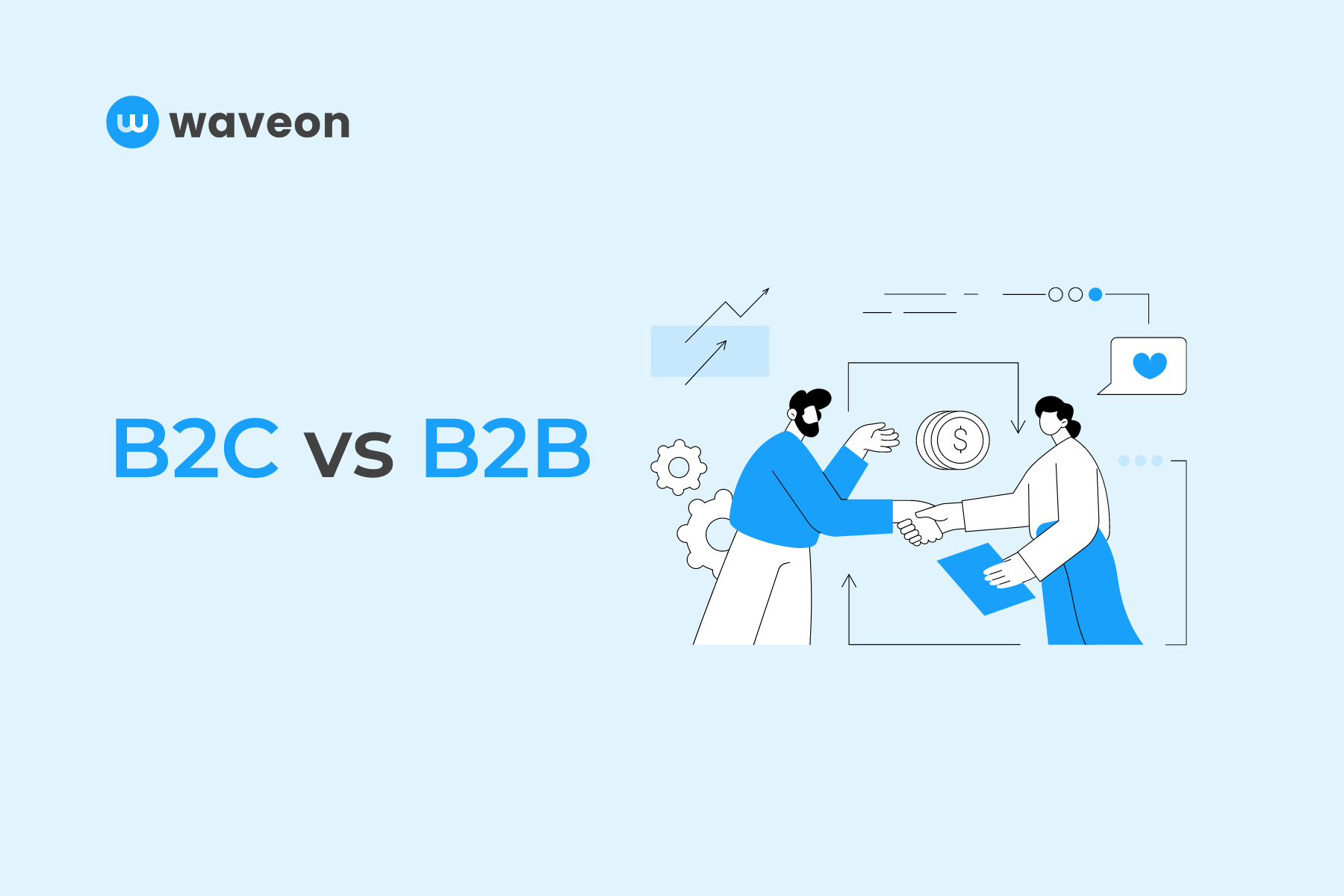
B2C vs B2B: Which is More Profitable?

Waveon Team
3/5/2023
0 min read
When it comes to running a business, one of the key decisions that needs to be made is whether to focus on selling products or services to consumers (B2C) or to other businesses (B2B). Both approaches have their pros and cons, but ultimately, the profitability of each model will depend on a variety of factors.
Generally, and specifically in the SaaS industry, there are business types known to have slightly higher profit margins. In this article, we'll take a closer look at the B2C and B2B models, and discuss which one is more likely to be profitable for your business.
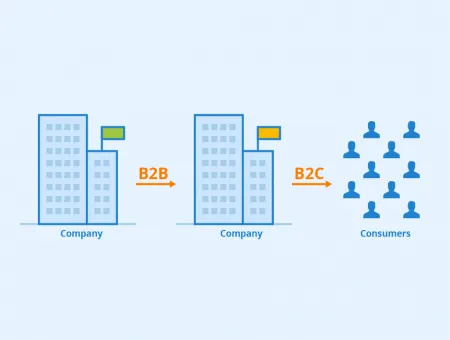
Source: seobility
Understanding B2C
B2C stands for "business-to-consumer" and refers to companies that sell products or services directly to individual consumers. For example, there are forms such as clothing stores, restaurant online marketplaces, and in the case of SaaS, there are products that are well-loved by many, such as Notion or Dropbox, although finding a B2C type in SaaS can be a bit difficult. (Of course, these products also conduct B2B businesses, not just B2C.)
Advantages of B2C
Large customer base: Since B2C companies target individual consumers, their potential customer base is much larger than that of B2B companies.
Shorter sales cycle: Consumers generally make purchasing decisions quickly, which means that B2C companies can often close sales more quickly than B2B companies.
Lower transaction costs: The average transaction value for B2C companies is typically lower than that of B2B companies, which means that transaction costs (such as shipping and payment processing fees) are also lower.
Challenges of B2C
High competition: Because the consumer market is so large, there is often a lot of competition among B2C companies. Also, because the barriers to entry are low, there are advantages, but there are also many cases where many people start businesses and it becomes saturated.
Lower profit margins: While B2C companies may have a larger customer base, the average transaction value is lower, which means that profit margins may also be lower. Therefore, in order for a business to grow, it needs a lot of consumers.
Understanding B2B
B2B stands for "business-to-business" and refers to companies that sell products or services to other businesses. Examples of B2B businesses include manufacturers, software providers, and marketing agencies, in the case of SaaS, almost all SaaS takes the form of B2B.
Advantages of B2B
Higher profit margins: Since B2B transactions typically involve larger sums of money, profit margins can be much higher than those of B2C companies.
Long-term relationships: B2B sales often involve building long-term relationships with clients, which can lead to repeat business and increased profits over time.
Niche markets: B2B tends to target niche areas compared to B2C, so there is less competition. Since B2B often solves specific problems in businesses, there is relatively less competition, and if done well, it is possible to quickly dominate the market.
Challenges of B2B
Longer sales cycle: B2B sales often involve multiple decision-makers and a longer sales cycle, which can make it more difficult to close deals quickly.
Smaller customer base: While B2B companies may be able to charge more for their products and services, the potential customer base is often smaller than that of B2C companies.
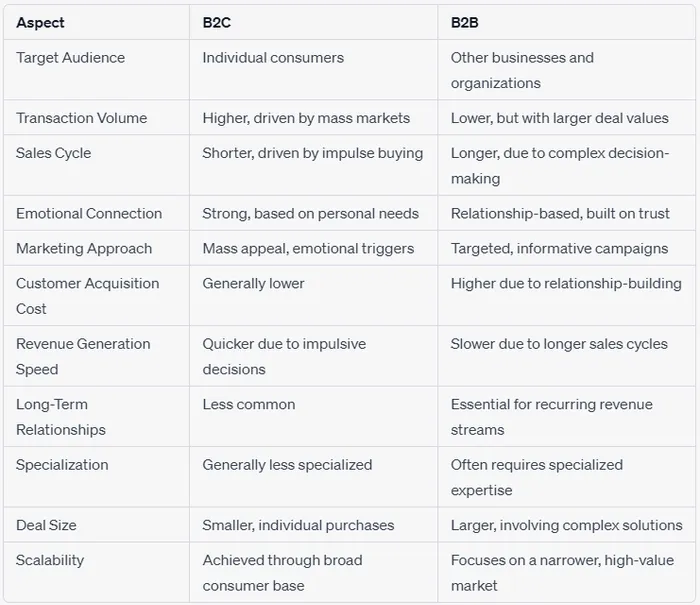
B2C Profitability Factors:
B2C ventures engage directly with individual consumers, leveraging mass markets for products or services. This model boasts several avenues for profitability:
Volume and Reach: B2C businesses tap into a larger customer base due to the sheer number of potential consumers. This volume can lead to higher sales, provided the product resonates with a wide audience.
Emotional Connection: B2C products often focus on fulfilling personal needs and desires, allowing for strong emotional connections. These connections drive brand loyalty and repeat purchases.
Impulse Buying: The B2C model benefits from consumers making impulsive buying decisions, driven by emotions or trends. This can lead to shorter sales cycles and quicker revenue generation.
B2B Profitability Factors:
B2B operations center around providing products or services to other businesses. Profitability in this model is influenced by:
Higher Deal Values: B2B transactions typically involve larger deal sizes due to the complexity of the solutions and the scale of operations involved.
Long-Term Relationships: Building long-term relationships with B2B clients can lead to recurring revenue streams through contracts, subscriptions, and service agreements.
Specialization and Expertise: B2B offerings often require specialized expertise, allowing businesses to command premium prices for their services.
Which is More Profitable?
So, which approach is more likely to be profitable for your business: B2C or B2B? The answer ultimately depends on a variety of factors, including the nature of your products or services, your target market, and your overall business strategy.
However, in the case of SaaS, there may be various controversies, the probability that B2B types will earn more revenue than B2C is higher. Why is that?
1. High Churn Rate
For SaaS, the churn rate is higher for B2C than for B2B. According to related data, the average churn rate for B2C SaaS is 6.77%, while for B2B, it is 4.91%. This means that B2C has about 40% higher churn rate than B2B.
Churn rate is critical for SaaS businesses. As explained in the article What is Churn and Why is it Important?, high churn rate can be a fatal flaw for SaaS businesses that rely on subscription models. If the churn rate is high, pouring money into the business will not help, as the users who leave will have a negative impact on the overall business, causing it to stagnate rather than grow.
Also, compensating for a high churn rate requires either a substantial marketing budget or ongoing marketing efforts. Recently, some AI tools that automate marketing actions and offer high ROI margins have been able to offset the effects of churn. Still, a high churn rate is a clear sign of a leaky bucket in your business.
2. Intense Competition and Low Purchasing Power
Another reason for the high churn rate in B2C, as seen in the disadvantages of B2C mentioned earlier, is the intense competition in the market. Since B2C tends to focus on limited fields (such as e-commerce, education, entertainment, etc.) compared to B2B, this competition is accelerating.
Furthermore, individual customers have weaker purchasing power than business customers, and there are fewer factors that make them continue to pay continuously compared to B2B. If B2B sees an increase in revenue, there is enough motivation to continue using the product. However, individual customers generally use the product for personal convenience or pleasure, so such motivation is weaker than in B2B.
Conclusion
B2C and B2B each have their own advantages and disadvantages, and which business model is more profitable depends on the industry, field, and situation. B2C has the advantage of having many customers, a short sales cycle, and low entry barriers, but it also has the disadvantage of intense competition and low profit margins.
B2B has the advantage of high profit margins and retention rates, and less competition, but has the disadvantage of a long sales cycle and fewer customers. For SaaS, B2B has a higher churn rate than B2C, less competition, and a higher average revenue per user, making it more profitable.
👉 📚 The 10 Core Principles of a Lean Startup — See All Posts
Learn more about No-code insights
Subscribe Waveon Newsletter
*Type your email address