Startup
How Startups Can Reduce Expenses: 7 Proven Approaches That Work

Waveon Team
9/11/2025
0 min read
Most early-stage startups fail not because the idea is wrong, but because cash runs out before product-market fit is reached. Reducing expenses is not about cutting corners. It is about making deliberate choices so your runway lasts long enough to find what works.
This guide covers seven proven approaches that startups use to reduce expenses without sacrificing speed or quality. Each applies from day one and scales as you grow.

1. Right-size your team before you hire
Payroll is typically 60 to 80 percent of total operating costs. Every full-time hire adds a fixed monthly obligation regardless of revenue. The most effective way to reduce expenses early is to delay full-time hiring until the role is genuinely necessary.
- Use contractors first for design, finance, legal, and marketing. If the work is under 20 hours per week, a contractor is almost always cheaper when you factor in benefits, equipment, and onboarding.
- Hire generalists early, specialists later. An engineer who can also set up analytics, or a PM who handles customer calls, reduces headcount while keeping output high.
- Delay specialist roles like dedicated data scientists or HR managers until that function is too large for a generalist to manage.
2. Audit and consolidate your SaaS subscriptions
The average startup carries 20 to 30 software subscriptions within two years. Many overlap in functionality or are used by fewer than half the team. A monthly audit is one of the fastest ways to cut recurring costs with zero impact on output.
For each tool, ask:
- Is it used by more than half the team at least once a week?
- Does it do something another tool we already pay for cannot?
- Would removing it take more than two hours to replace?
Most teams eliminate 20 to 40 percent of SaaS spend in a single audit. Common culprits: duplicate project management tools, underused analytics platforms, and legacy integrations from earlier product phases.
Tip: Most SaaS vendors offer 20 to 30 percent discounts for annual prepayment. Many also have startup programs. Stripe, HubSpot, Notion, AWS, and Google Cloud all offer significant credits for early-stage companies.
If you are evaluating which website tools are worth keeping, see our comparison of the best startup website builder tools for lean startups — including which ones offer startup pricing and where free tiers run out.
3. Use shared office space or go fully remote

A dedicated office lease is one of the largest fixed costs a startup can take on. In major cities, per-seat costs range from $500 to $1,500 per month including rent, utilities, and furniture.
| Option | Cost vs. Dedicated Lease | Best For |
|---|---|---|
| Dedicated lease | Baseline | Teams of 20+ with stable headcount |
| Coworking (private office) | 40 to 60% less | Teams of 2 to 15, flexible growth |
| Fully remote | Near zero | Engineering, design, marketing, support roles |
Remote-first also opens access to talent in lower cost-of-living markets. Hiring a senior engineer at 30 to 40 percent below a primary market rate saves more than enough to cover the tools needed to make remote work effective.
4. Reduce customer acquisition cost with data-driven marketing

Marketing budgets at early-stage startups are frequently wasted on broad campaigns before the target audience is clearly defined. Stop spending on channels where you cannot measure the outcome. Double down on channels where you can.
- Start with owned channels. Content marketing, SEO, and community participation have near-zero marginal cost per lead once established. Two to four high-quality articles per month outperform daily low-quality publishing every time.
- Measure attribution before scaling paid. Know your cost per acquisition by channel and audience segment. Without that, increasing ad spend typically increases cost without proportionally increasing revenue.
- Cut underperforming segments first. Teams that do this typically achieve the same or better revenue at 30 to 50 percent lower marketing spend.
5. Negotiate with vendors and service providers
Most startup founders accept vendor pricing at face value. In practice, vendors regularly offer better terms to customers who simply ask. A few high-value negotiations:
| What to Negotiate | Typical Outcome |
|---|---|
| Annual prepayment | 10 to 25% discount |
| Extended payment terms (net 30/60) | Better cash flow, same cost |
| Volume commitment | Unlocks pricing tiers not publicly listed |
| Fixed project scope (agencies) | Eliminates cost overrun risk |
6. Automate repetitive operations early
Manual processes that take 30 minutes per day add up to over 100 hours per year per person. For a five-person team, eliminating two hours of daily manual work is the equivalent of a part-time hire — without the cost.
High-impact automation targets for early-stage startups:
- Customer onboarding sequences
- Invoice generation and payment reminders
- Lead routing and CRM updates
- Social media scheduling
- Internal reporting
Prioritization framework: identify tasks that happen more than three times per week, take more than 15 minutes each, and follow a consistent pattern. Start with highest-frequency tasks first. Tools like Zapier, Make, or native workflow features in tools you already use can handle most of these.
7. Use an AI website builder to reduce development costs
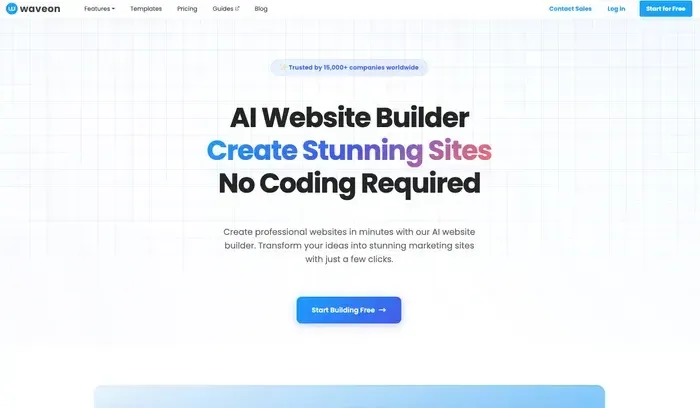
A professional website is a core asset for nearly every startup, but hiring a developer or agency is expensive and creates a dependency that makes future updates slow. An AI website builder removes that dependency entirely.
Changes that previously required a developer can now be done by a product manager or marketer in minutes:
- Adding a testimonials or reviews section
- Updating pricing copy or headlines
- Translating content into a new language
- Creating a landing page for a new campaign
- A/B testing different CTAs or messaging
The compound effect matters. Startups that can test a new headline or revised product description the same day they have the idea move faster through the product-market fit process than those waiting days for development resources.
How Waveon helps
Waveon is an AI website builder designed for teams that need professional results without developer dependency. Describe what you want in plain language, and Waveon builds or modifies the page. It includes templates purpose-built for common startup use cases and integrates directly with analytics tools so you can measure the impact of every change.
If you are comparing your options, this guide to the best AI website builder tools for startup landing pages breaks down what each tool actually does and where it fits in your stack. For a practical walkthrough, see the step-by-step guide to building a product launch landing page using AI templates.
To see it in action, start with a startup landing page that lets your team test product positioning, lead capture, and campaign messaging before committing more development budget.
A simple cost reduction framework
These seven approaches work best applied as a continuous practice, not a one-time exercise:
| Cadence | Action |
|---|---|
| Monthly | Review SaaS subscriptions. Check marketing attribution and reallocate away from high-cost, low-conversion channels. |
| Quarterly | Reassess headcount needs. Identify manual processes ready to automate. Renegotiate contracts up for renewal. |
| Annually | Review office footprint. Audit full vendor and contractor list against current priorities. |
The goal is not to minimize spending as an end in itself. It is to maximize output per dollar of runway so each month moves you closer to sustainable growth. Start with a lean landing page workflow to see how much faster your team can iterate on your website, campaign copy, and customer acquisition tests without developer dependency.
👉 📚 The 10 Core Principles of a Lean Startup — See All Posts
Learn more about No-code insights
Subscribe Waveon Newsletter
*Type your email address


.png)